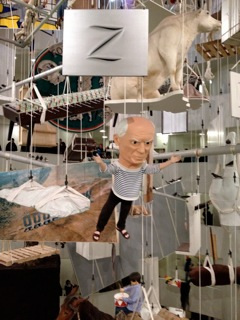
 Maurizio Cattelan at Guggenheim Museum. Photo by Marianne Vecsey A giant foosball table for 11 players per side? Horses suspended in mid-air? Picasso in the sky with sandals? A giant tombstone cataloguing England’s soccer losses (no victories whatsoever)?
Maurizio Cattelan insists he is retiring, not that I believe him for a moment. But Sig. Cattelan certainly gives new meaning to the dreaded R-word. The Guggenheim Museum held a celebration of voluntary endings on Saturday night. The ramparts of the Frank Lloyd Wright building were jammed on the final weekend for the show – Sig. Cattelan’s letting it all hang out, so to speak. Just about his entire output of 51 years on this earth was suspended from the ceiling. I have seen many athletes take their leave of the arena, rarely on their own. When I was as young as the players, some of my friends on the Yankees would talk in hushed tones about a player who had been cut from the team. “Hey, did you hear about so-and-so? He died.” A bunch of people from various disciplines were asked by the Guggenheim to illustrate voluntary retirement. In men’s sports, retirement is often connected to that intimate item of sporting equipment known as the athletic supporter, or jock, which protects what any male athlete would say are his most treasured possessions. When a player retires, I reminded the audience, he is said to “hang up his jock.” Not being much of an athlete myself, I wanted to know if athletes actually “hang it up.” I contacted some of my athlete friends from my days at Hofstra College on Long Island. Stephen Dunn, who won the Pulitzer Prize for poetry in 2001, was a fine player on the basketball varsity that had a 23-1 record in 1959-60. Stephen was known as Radar for his long-range accuracy, and later played in a weekend professional league. When I asked Stephen about the end of his active basketball career, he wrote to me. (Yes, that Pulitzer-prize poet uses email.) “The jock strap, in this regard, has a kind of moral, uplifting quality to it,” Stephen wrote. “When I hung mine up it was a day of sadness, but only for me.” He added that only his wife noticed his “retirement” – and she did not think it was a big deal at all. Another friend from the old days, Lou DiBlasi, went on to be a high-school coach and has written a book about the legendary Tiny Twenty team of 1956. He also played on the undefeated Hofstra team in 1959. After their final victory, they held what he described as a “hang ‘em up ceremony,” which involved pounding some nails into a board, writing the names of the seniors, and hanging up their jocks, accompanied by, I am assuming, copious amounts of beer. The captain of that team was in the hospital for that final game, because of an appendectomy. They infiltrated the hospital with the beer and the board, and hung up his jock, too. At the Guggenheim, I gave what I hope was a brief talk on the history of retiring athletes’ numbers – Lou Gehrig’s No. 4 on July 4, 1939 (the day I was born; I remember the hubbub quite well.) The Yankees will soon run out of single-digit numbers after they retire Torre 6 and Jeter 2. Other speakers talked about forms of voluntary change – one man had given up the priesthood; a woman talked about contraception; a psychiatrist talked about endings in her field; a man did a spin on jarring black standup comedy that I loved; and somebody else talked about what I guess you could say is the ultimate form of voluntary retirement – suicide notes, themselves an art form. By contrast, “hanging it up” seems delightfully benign. We didn’t stay for the scheduled Courtney Love finale around midnight. As I left, I could see the young and the hip congregating underneath Maurizio Cattelan’s mock animal skeletons and newspaper headlines about the Brigati Rossi and busty nude sculptures. I’ll believe the retirement when I see it. Meantime: Bravissimo, Ingeniere.
Hansen Alexander
1/23/2012 04:54:40 am
Enjoyed your rift on retirements: a brilliant combination of sports, careers in general, Hofstra basketball, and art. Splendid and
AltenirSilva
1/23/2012 10:45:32 pm
Hi George,
George Vecsey
1/24/2012 12:41:38 am
Altenir: Muito obrigado. 1/29/2013 02:44:48 am
I like the way you described the topic with such clarity. This is something I have been thinking about for a long time and you really captured the essence of the subject. 2/2/2013 07:50:04 pm
Sometimes it is so hard to find good and useful posts out there when doing research. Now I will send it to my colleagues as well. Thank you for being one of them. 4/2/2013 03:07:32 am
I want a giant foosball with 11 players on one side. I law foosball but I haven't played it in a long time. 4/2/2013 03:11:28 am
I really enjoyed reading this story because I found out some new things. Thanks a lot! 10/9/2013 08:04:57 pm
Health and Beauty is producing and marketing top quality cosmetic products. These cosmetics are produced with Dead Sea minerals and vitamins enriched with plant extracts and aromatic oils, to make your skin healthy and glowing. 10/21/2013 11:56:12 pm
I was finding the solution of my assignment and finally I found your blog. We all know literacy rate is increasing very rapidly and people are becoming more conscious about the study. 10/31/2013 09:13:27 am
This is truly a great blog thanks for sharing. Excellent and decent post. I found this much informative, as to what I was exactly searching for. Thanks for such post and please keep it up. 3/3/2014 07:21:32 pm
And I don’t know if you’ve ever seen her do an interview but she is also rather funny and it all seems to come so natural for her 8/12/2016 03:26:21 pm
Thanks for sharing excellent informations. Your web site is very cool. Comments are closed.
|