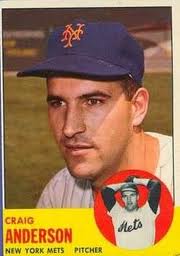
 Won a Doubleheader; Anything Was Possible On May 12, 1962, Craig Anderson won both ends of a doubleheader in relief for the expansion team called the Mets. He had every reason to think maybe he and the Mets were going to be all right. Instead, Anderson never won another game in the major leagues, losing 19 straight decisions over three seasons. By doing so, Anderson became a legendary Met from the early years, along with Marv Throneberry and Choo-Choo Coleman and of course Casey Stengel. Fifty years is a perfect time for gauging this franchise, built on hope and dreams and irrationality and humor -- the veritable human condition, one could say. Those first weird days flavor everything fans feel about these current Amazing Mets, who are somehow over .500 under their pepper-pot manager Terry Collins. Norman Craig Anderson, epic Met, born in Washington, D.C., now 73, follows the Mets from Dunnellon, Fla., where he is an occasional substitute teacher, to keep his head young. He does not mind recalling the hopes that rose when he actually won both ends of a doubleheader. Anderson, a solid 6-2, 205-pound righty, was a college boy from Lehigh who had quite a decent debut with the Cardinals in 1961, as teams prepared to give players to the new teams in Houston and New York. In spring training of 1962, Stengel told the world the Mets could be contenders. Anderson looked around at Rich Ashburn and Gil Hodges and Roger Craig and figured, well, why not? As every Met fan knows, the Mets promptly lost 10 straight games at the start of 1962, but then actually came back to win a game here and there.. “Nowadays they never schedule a doubleheader, but they had a doubleheader scheduled for Saturday,” Anderson recalled. . On May 12, 1962, he was in the bullpen as the gallant Craig held off Henry Aaron and the Milwaukee Braves for seven innings. Anderson pitched the eighth and ninth innings, but the Mets were trailing, 2-1, with three outs left against Warren Spahn. Then Hodges singled and the instant folk hero, Hot Rod Kanehl, ran for him, and with two outs Hobie Landrith pinch-hit for Ed Bouchee. (Don’t you just love all these 1962 names?) Landrith promptly hit a fly ball that would have been an out in most ball parks but which became a classic Polo Grounds game-winning homer. The two teams came right back for a second game and staggered into a 7-7 tie going to the ninth inning. Anderson was the sixth Met pitcher, following Bob Moorhead, Bob L. Miller (the righty Bob Miller, not the lefty Bob Miller), Ken McKenzie, Dave Hillman and Vinegar Bend Mizell. He dispatched three Braves and then watched Hodges, the weary beloved idol of the Brooklyn Dodgers – Ulysses home from the wars – plop a home run into the friendly confines for another game-ending home run. “I was still in the dugout,” Anderson recalled by phone the other day. “Judy was in the stands. I came out and held up two fingers and she held up two fingers.” Then he began the trek to the clubhouse in deep center field. Anderson admits he was a little surprised when no reporter spoke to him, or did more than briefly mention his winning both ends of the doubleheader. This feat was not all that rare back in those manly days when pitchers were not protected by pitch counts. However, the doubleheader ended late on a Saturday afternoon, with early newspaper deadlines and the PM papers of the day not even having a Sunday edition. So Anderson showered and joined Judy and a Lehigh pal for dinner. “They next day I figured Casey wouldn’t use me,” Anderson recalled. But when Jay Hook gave up two runs in the eighth to fall behind, 3-2, Casey waved in Anderson for the ninth inning. “Classic Casey move,” Anderson recalled. “He’s thinking, maybe I’m a lucky charm.” Anderson held the Braves, but the Mets did not score. The next weekend in Milwaukee, Anderson saved two straight victories for McKenzie, out of Yale, and then Roger Craig saved a victory for Alvin Jackson, giving the Mets a 12-19 record. As of May 20, Anderson had a 3-1 record with a 2.38 earned-run average. “At that point, I really thought we were going to be competitive,” Anderson said. “What you don’t know is, it’s a long season. I was a young player and we had a lot of older players. If you had told me we would lose 17 straight, I’d have said, ‘no way.’” They did lose 17 straight, falling to a 12-36 record, and they maintained that .250 gait right through the end of the season, for a 40-120 record. By that time, Anderson had lost 16 straight, to finish with a 3-17 record and a 5.38 ERA. He started 14 games, completing two, but does not blame his slump on the irregular role. Anderson seems to have ambivalent memories of Stengel. Casey and Edna were childless, and were fond of some young couples, but Casey also seemed to harbor some old-school suspicion of players with an education. More than once I heard him grumble about college boys who had “ann-oo-it-ies” – he enunciated the syllables – meaning, I guess, in Stengelese, that they were a tad too secure. The Old Man was not easy to decipher. In one game, Stengel came to the mound to visit Anderson when the opponent was obviously going to bunt. “You know what to do,” Stengel said cryptically, and stomped off. Anderson assumed he was talking about covering first base on the bunt. Turned out, Casey wanted him to pitch inside, to move the batter away from the plate. The players came to realize Casey communicated mostly with his writers. The Mets sent Anderson to their Buffalo farm club in 1963 – Marvelous Marv was also exiled there – but recalled him often enough for two more losses, and then brought him back for an emergency start in the new Astrodome in 1964, and he lost that one, too. With a 19-game losing streak going, he retired from the minors in 1966 and went back to his alma mater, Lehigh University, where he served as pitching coach and assistant athletic director. In 2001, Lehigh inducted Anderson into its hall of fame. The ceremony was held on May 12, the anniversary of his last victory. When the Mets’ Anthony Young went on a losing streak in 1992-93 that would stretch to a staggering 27 games, Anderson sent him a letter urging him to hang in there. He remains a supportive teammate. Over the past winter, as the 50th anniversary loomed, Choo Choo Coleman emerged from the mists. Most of us had not heard from him in decades. Anderson made a few phone calls and made sure Coleman became eligible for the recent payout for players with less than four years in the majors, who did not qualify for a pension - a sliding scale of up to $10,000 a year for these two years. “A few weeks later I received the most beautiful note from Choo Choo, thanking me,” Anderson said, sounding touched. He is looking forward to the 50th anniversary of his last victory, which falls on a Saturday, the same day as 1962. He and Judy have never let the losing streak affect their self-image. “I reached the top level of my field,” Anderson said. “Better to be a has-been than a never-was.” Craig Anderson is much more than a has-been. In this milepost season, he is part of the DNA of every fan who agonizes over the Mets. 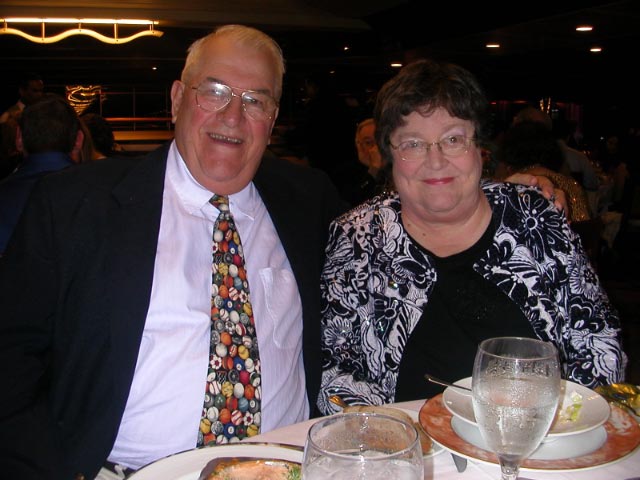 Craig and Judy Anderson on Their 50th Wedding Anniversary
bruce picken
5/10/2012 04:43:13 am
george, i often get the feeling that your enjoyment of those early days watching the mets makes them your second favourite team behind the islanders of bossy, trottier, smith, nystrom et al.
bruce picken
5/10/2012 04:54:37 am
SHOULD'VE googled spahn before i sent my first comment. had some great lines. i enjoyed the comment he made after giving up willie mays' first hit and this one..."I'm probably the only guy who played for Casey (Stengel) before and after he was a genius"
George Vecsey
5/10/2012 08:09:54 am
Spahn was in combat, I believe the Battle of the Bulge. Musial played ball at Pearl Harbor in 1945. My book tells about a line drive Musial hit that caught Spahn in a bad place.
bruce picken
5/10/2012 03:04:04 pm
george, i googled after i wrote the letter.thought stengel had it right with the fact he thought spahn was a coward, but was rather wrong. i remember spahn was mentioned in your musial bio. i often wonder if pro athletes--especially baseball and hockey players--who were in well established leagues during ww2 felt sports pressure was kind of easy after combat. read stuff about ted williams landing a fiery jet on a carrier or being in combat. i would think that worrying about hitting a curve in front of a crowd would somehow seem less than terrifying.....
Charles in Absecon
5/10/2012 08:13:50 pm
Great, fun stuff. Loved it.
Daviault
5/11/2012 04:11:39 am
I saw what might have been the best game he ever pitched, my first visit ever to the Polo Grounds, July 7, 1962: a complete game loss, 3-2 on solo HRs by Musial (2) and Boyer. It was the nightcap of a doubleheader in which the Mets won the opener on what today would be called a "walkoff" pinch 2-run HR by Throneberry. Marv hit a two-run triple in the 9th of Anderson's game, but Gene Woodling stranded him there. That loss began a 3-22 stretch for the Amazin's.
george vecsey
5/11/2012 07:51:38 am
nice name, monsieur -- et merci
Altenir Silva
5/11/2012 06:05:45 am
Hello George,
George Vecsey
5/11/2012 07:53:35 am
Altenir: As your hero Fitzgerald might say, there was no happy second baseball act -- but a productive and happy civilian life after the Mets. Best to you in Brazil. GV 5/11/2012 08:09:40 am
George,
bruce picken
5/11/2012 12:22:35 pm
hansen, your mention of ron hunt reminded of the story when hunt set the major league record for hbp. think he was playing for the expos. one of the writers said something like, 'the old-timers can't complain about this record not being as legit as in the old days.' hunt said, 'nah. they just claim the ball is softer today....'
Hansen Alexander
5/12/2012 05:10:07 am
Bruce,
Roger Cantor
5/12/2012 01:45:50 am
i played baseball in the late 80's at Lehigh under Coach Anderson. He still had a good slider working when he threw batting practice. Thanks for the nice article.
George Vecsey
5/12/2012 03:58:03 am
Roger, thanks for the nice note. My friend Paul played for at Lehigh for Wagner in the late '50's and said somebody pointed out the spot at Lehigh where Walt Dropo hit a mammoth home run for UConn over the center-field fence. Craig confirmed it -- but he was not the pitcher. Long before his time. 6/11/2013 01:43:23 am
Thanks for describing the career life of Craig Anderson over here. It was an inspiring one and the way you pinpointed your thoughts is an effective one for others to follow. Based on this experience I am going to write on my blog and thanks. Comments are closed.
|