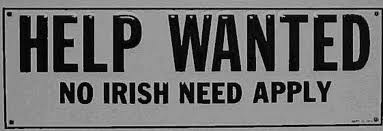
Did these signs exist? The point is, there are always newcomers
As the holder of an Irish passport (as well as my American passport), I think I can safely ask just exactly what Bill O’Reilly is trying to say.
O’Reilly tried to wax profound last week after President Obama was re-elected with help from African-American and Hispanic votes. (One perky guest on MSNBC suggested a new motto for the Republican party: “Hello, Brown People.”) On Election night, O’Reilly said: “It’s a changing country, the demographics are changing. It’s not a traditional America anymore, and there are 50 percent of the voting public who want stuff. They want things. And who is going to give them things? President Obama.” O’Reilly added, “The white establishment is now the minority.” In noting the shift in America, O’Reilly seemed to be harking back to some golden era in America when the Cabots and the Lodges sat around the Boston Common and sang Kumbaya with the Flynns and, dare I say it, the O’Reillys. Was there ever a time in America when we were all just one happy family? After the settlers took the country away from the native Americans, that is. There were always newcomers to the land and the voting booths. They were noticeable by their clothes and their accents, if not their color. It isn’t quite clear to me whether some of my Irish ancestors (on my maternal grandmother’s side) ever ran into help-wanted signs that said NINA – No Irish Need Apply. Did those signs actually exist in large numbers in the 19th Century, as some people claim? In a way, it doesn’t matter. There are always newcomers, always outsiders. And it’s funny how new people want things, like work and housing and education and a chance to vote, without public officials in Ohio and Florida making it tough for them. O’Reilly seemed downright lachrymose when confronting the new reality – that voters of color now tilt the majority and helped re-elect a candidate who, despite being Kenyan and Muslim and, worst of all, an introvert, just might be the smartest person in the political room. The country keeps changing. Always did.
Ed Martin
11/14/2012 03:31:06 am
Yes they did exist. Peggy's grandad, Ned Monaghan, came at twelve from County Fermanagh by himself. Eventually worked as a meter reader for the Boston area Gas company, He saved enough money to try to buy a house in Wellesley Hills but they would not sell to Irish/catholic, either one. A Protestant friend at the Gas company bought the house and resold it to them, where they lived out their lives. PS. We went to Ireland and after almost 100 years of not knowing of each other, Peggy found her family. I can still here the cry, "Sweet Jasus" from cousin Sheilah!
George Vecsey
11/14/2012 04:29:49 am
I'm sure the conditions existed. Your story is very American. The essay I linked on my site says it is hard to find examples of the sign itself. The sign I used is a contemporary sign, found on-line. The essay:
Ed
11/15/2012 03:00:34 pm
you are right George, I jumped past the literal to the feeling, which was not your point.
John McDermott
11/14/2012 05:21:05 am
They didn't need to exist where I grew up. You just knew you weren't particularly welcome in certain circles. And I'll just bet that our President, like many before him, can trace at least some part of his family tree back to Ireland. President O'Bama...I like the sound of that. 11/14/2012 09:28:10 am
Everyone should have some Irish in them. It is a rich and diverse culture.
Ed Martin
11/14/2012 01:59:31 pm
Everyone should have some Jewish in them. It is a humane and diverse culture. Actually those of from the NYC area, have absorbed some of each, if not genetically, then through the air.
Brian Savin
11/14/2012 02:55:24 pm
My late business partner was born in Paris and remained a true blue "Frenchman" all his life, but married an American doctor, who is black, and much preferred living in the United States because the country inspired him in ways that invigorated him. He thought the U.S. (he hated it when anyone called our country "America" -- insult to the the Canadians and Latins in his mind) was very special because we were different. What made us different in his mind was that we were multi-cultural and actually a melting pot. That is why things happened here, innovative thinking, that just couldn't happen in Europe. And he would point to examples. I'll give one:
George Vecsey
11/15/2012 11:52:07 am
Thanks, guys. That was the general experience. Comments are closed.
|