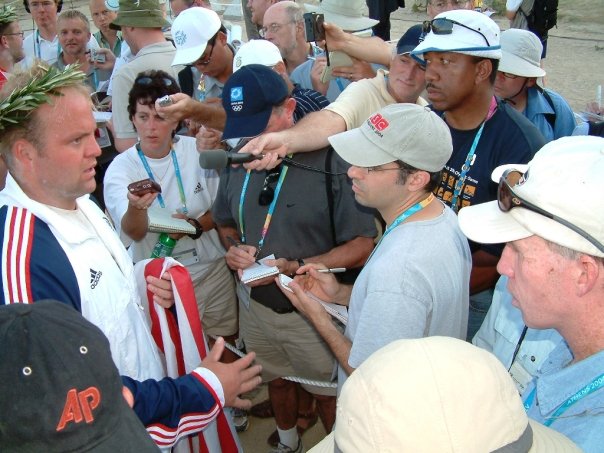
 Adam Nelson, 2004. My pals Karen Rosen, Bryan (aka Home Slice) Burwell (dark shirt; white cap) and Tim Layden (glasses on cap). Photo: Stratos Safioleas. It all comes back to me now – the heat, the dust, the antiquity, the frustration when Adam Nelson could not prevent his foot from squiggling over the foul line. By the slimmest of margins, Nelson fouled on his final shot in the 2004 Summer Games, which meant somebody else won the gold medal by virtue of a tiebreaker. Nelson had two millenniums of history all around him on the most memorable day of the entire Olympics. The hosts had placed a medal event at the site of the ancient Games – the shot-put for men and women, fairly contained in one small corner of the old field. I remember arriving the night before, walking the grounds in the dark with a few friends, sensing the old Olympians in the cosmic dust. Every step, every breath, was a privilege. Competitors and their followers had walked these hills and paths long ago. Everybody got it, from the spectators to the athletes to the reporters. My daughter Laura Vecsey, then with the Baltimore Sun, made the trip out from Athens. This was the best day. "It was surreal," said Cleopatra Borel, a shot-putter from Trinidad, who did not win a medal, but was exhilarated all the same. "You can't believe that athletes just like myself competed here. I know it was an all-male environment back then. This can never, ever happen again like this. Even if they ever have something back here, it can never be like this again." Borel was right. Now, eight years later, that day in ancient Olympia is being re-arranged. The sample from Yuriy Bilonog of Ukraine has been judged to contain an illegal substance, untraceable by methods available in 2004. It looks like Adam Nelson is going to get his gold medal. There is a warning out to all the cheaters, in all the sports. Be careful, pal; time and pharmacology may judge you yet. The news about Nelson’s gold medal: http://www.nytimes.com/2012/12/06/sports/four-2004-olympians-stripped-of-medals-in-doping-re-test.html The column I wrote from Olympic in 2004: http://www.nytimes.com/2004/08/18/sports/olympics/18CND-VECSEY.html?pagewanted=all 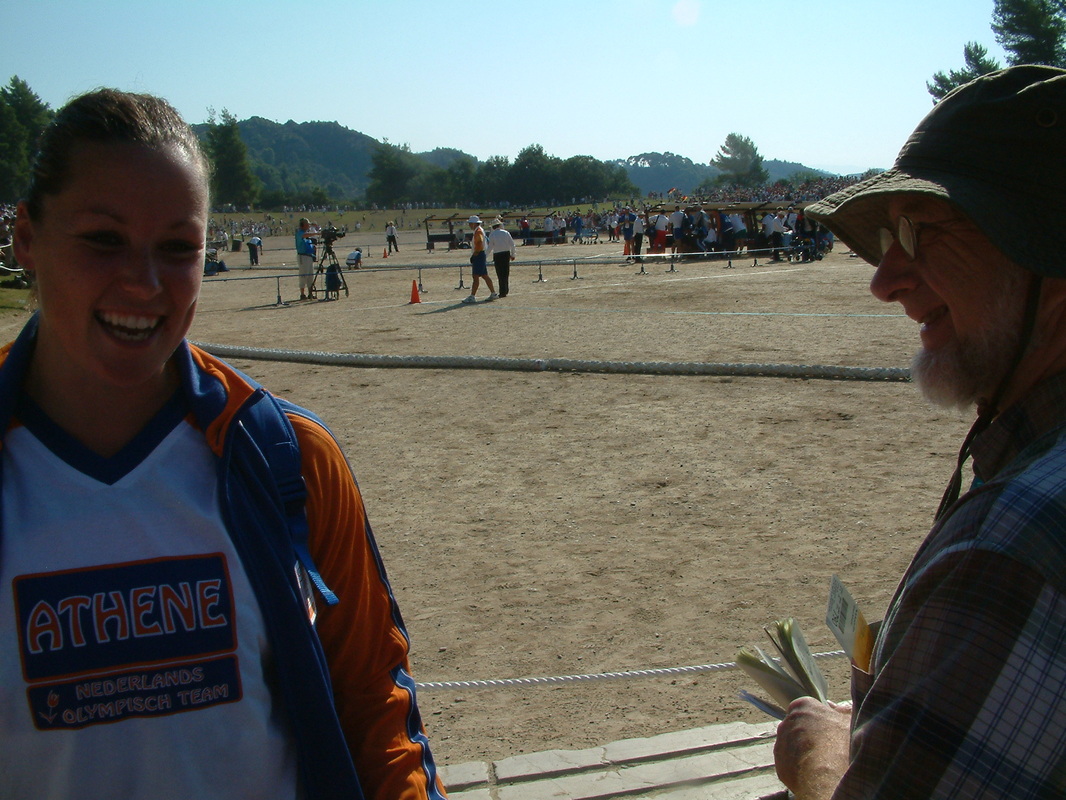 Interviewing a competitor in Ancient Olympia.(Photo, Stratos Safioleas)
Barbara Alpert
12/8/2012 05:57:49 pm
Hi George,
George Vecsey
12/9/2012 01:03:24 am
Barbara! 12/4/2013 02:36:31 pm
http://www.myfreecreditreportx.com/how-many-free-credit-reports-per-year-are-you-entitled-to Such a good event 12/9/2012 06:09:09 am
George
Brian Savin
12/11/2012 11:37:52 am
Raises interesting and important questions. What is "sport"? What is "amateur?" What is "cheating"? The Olympics is about national politics, having nothing to do with those questions. The brightest person I ever met (and not really a cynic) said to me that most every human interaction these days is about power, sex or money. Altruism? Not much. A foot on the line? In the scheme of the way this competition actually works, why should that be any big deal? The Olympics story is a sad story in need of top to bottom reform that is not likely to come. And that leads to even larger questions about why we still innately know that sport is important.
credit report
11/12/2013 01:01:31 pm
Nice writeup. I enjoy your posts and agree with your opinions. keep it up <a href="http://www.myfreecreditreportx.com/what-are-the-3-credit-bureaus" rel="follow">who are the 3 credit bureaus</a> 8/5/2013 11:16:10 pm
Zest is the secret of all beauty. There is no beauty that is attractive without zest.
credit
12/12/2013 01:11:02 pm
http://www.myfreecreditreportx.com/how-many-free-credit-reports-per-year-are-you-entitled-to Pretty! This has been a really wonderful post. Thank you for supplying this information. - I agree with you 10/1/2013 11:08:30 am
Pretty! This has been a really wonderful post. Thank you for supplying this information.
credit
12/16/2013 01:18:56 pm
[url=http://www.myfreecreditreportx.com/how-many-free-credit-reports-per-year-are-you-entitled-to/]how many free credit reports do you get[/url] It's very helpful that you shared this information. Thanks Comments are closed.
|